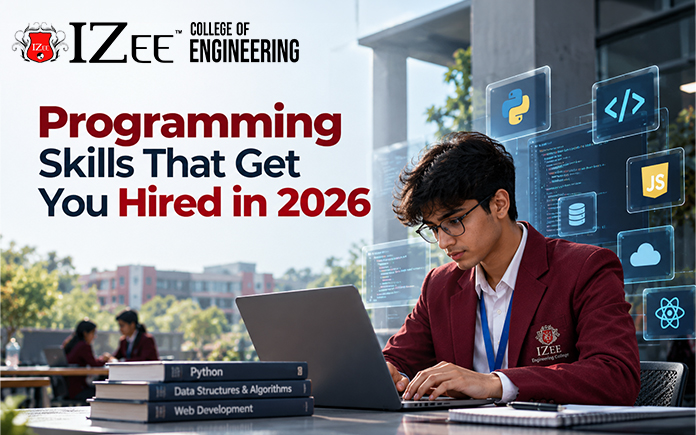
The programming skills that you develop can either make or break your career. The various languages you can learn to improve your employability in 2026 include Python, JavaScript, TypeScript, Java, SQL, and C++, along with skills like problem-solving, debugging, database management, etc. Whether it is software development, web development, data analytics, Artificial Intelligence (AI), or enterprise application development, they all require different skills. During your graduation or after it, the skills you develop decide which path you can go on in your career. To choose these skills and the best programming languages to learn in 2026, you need to first learn how useful they are for your future.
Why Are Programming Skills for Freshers Important to Build?
Different programming skills, as well as technical skills for software developers, involve problem-solving, developing applications or websites, and serving various purposes in software engineering, IT services, product development, analytics, and emerging technology fields. If you are pursuing a course in information science engineering in Bangalore, then now is the best time to understand why programming skills are important for you to build.
- Improve placement readiness.
- Expands potential career opportunities.
- Gives you practical experience.
- Supports adaptability with new tools and technologies.
What Are the 10 Best Programming Languages to Learn in 2026?
Along with the skills, you should also learn about the best programming languages to learn in 2026. Whichever language you choose defines what your future will look like in terms of your career. The following are the top 10 programming languages to learn in 2026:
1. Python
Python is a very beginner-friendly language used for automation, data analysis, and backend development.
- Skills to learn: The use of variables, functions, loops, object-oriented programming, file handling, and APIs.
- Uses: Data analysis, machine learning, automation scripts, backend applications, and testing.
2. JavaScript
JavaScript is a core language used in website and server-side development. Demand for this language makes it one of the most important programming skills for jobs which you need to learn.
- Skills to learn: DOM manipulation, asynchronous programming, promises, ES6+ features, & API integration.
- Uses: Development of interactive websites, web applications, server-side programming, and browser-based tools.
3. TypeScript
TypeScript is used by developers across the world to identify errors before running their code.
- Skills to learn: Types, interfaces, generics, type narrowing, and configuration of compilers.
- Uses: Large web applications, frontend development, and maintainable JavaScript-based services.
4. Java
The use of Java is one of the most crucial programming skills for freshers, as it is used in enterprise software and backend systems.
- Skills to learn: Object-oriented programming, basic data structures, and exception handling.
- Uses: Development of enterprise applications, backend services, and different projects for Android.
5. SQL
Structured Query Language (SQL) is used to store, retrieve, update, and analyze data in relational databases, hence forming one of the most in-demand programming languages for the present as well as the future.
- Skills to learn: SELECT queries, joins, filtering, grouping, subqueries, indexes, and database design.
- Uses: Application databases, reporting, business intelligence, and data analysis.
6. C++
One of the most useful programming languages for beginners is C++, used with a heavy dependence on memory management, performance, and competitive programming focusing on algorithms.
- Skills: Pointers, references, object-oriented programming, algorithms, and memory management.
- Uses: Development of game engines, performance-sensitive applications, and systems software.
7. C#
C# is a great programming language for you to learn if you are interested in working on enterprise applications, backend services, desktop software, and game development.
- Skills to learn: Classes, interfaces, LINQ, asynchronous programming, exception handling, and dependency injection.
- Uses: Enterprise software, web APIs, Windows applications, and games.
8. Go
Learning Go, also popularly known as Golang, is one of the best software developer skills for managing backend services and cloud infrastructure.
- Skills to learn: Structs, interfaces, error handling, goroutines, channels, and testing.
- Uses: Cloud services, networking tools, backend APIs, and infrastructure software.
9. PHP
PHP is a server-side language used to build websites and web applications and also work on content management systems.
- Skills: Object-oriented programming, sessions, security, and database connectivity.
- Uses: Development of websites and Content Management Systems (CMS).
10. Kotlin
Kotlin is a programming language used in Android application development. Professionals mainly use it with Java libraries to reduce repetitive code.
- Skills to learn: Null safety, classes, collections, coroutines, and asynchronous programming.
- Uses: Android apps, mobile application development, and some backend services.
How to Develop In-Demand Programming Skills?
Your programming skills need to be developed and honed with consistent efforts driven by your interests. Experts in the information science engineering field recommend that to develop any skill, you should start by learning its fundamentals, followed by applying them on projects while aligning them with the project’s needs, writing code, and fixing errors.
1. Choose a Language Based on Your Career Goal
Your first language should support the type of work you want to build your career around.
- Web development: JavaScript, TypeScript, SQL, HTML, and CSS
- AI and data science: Python and SQL
- Enterprise software development: Java and C#
- Mobile development: Kotlin
- System programming: C and C++
2. Practice Data Structures and Algorithms
By practicing Data Structures & Algorithms (DSA), you can understand how to organize information and solve computational problems.
- Practice arrays, strings, linked lists, stacks, queues, trees, graphs, and hash maps.
- Learn about sorting, searching, recursion, and basic dynamic programming.
- Understand time and space complexity by using Big O notation.
3. Build Projects That Solve Real Problems
Nothing can help you build in-demand programming skills like practical work. Start making some small-scale projects that can also go in your portfolio later on.
- Connect your application to a database and an API.
- Upload your code to GitHub with a clear README document explaining its use, setup, and limitations.
4. Learn Git, Testing, and Debugging
Once you develop good enough coding skills for beginners in the language you have chosen, you have to learn testing, debugging, and working in collaboration with others.
- Learn Git commands, branches, commits, merges, and pull requests.
- Write unit tests and test important edge cases.
- Use a debugger, read error messages, and trace problems systematically.
- Understand basic command-line operations and how to configure a development environment.
5. Use AI Coding Tools Responsibly
To make yourself future-ready while learning the most in-demand programming languages, you should also explore the use of AI coding assistants and how much they can help you. While using an AI coding tool:
- Review generated code and verify that it meets the requirements.
- Test outputs with normal, boundary, and invalid inputs.
- Avoid sharing passwords, API keys, private datasets, or confidential information.
- Practise solving problems independently so that you can explain your reasoning during interviews.
How Do Programming Skills Impact Your Career Scope?
The programming skill you choose to develop impacts the career path you can walk on, hence influencing your whole career.
| Career path | Programming skills |
| Software Developer | Java, Python, C++, or C# |
| Frontend Developer | JavaScript, TypeScript |
| Backend Developer | Java, Python, JavaScript, or Go |
| Data Analyst | SQL, Python |
| AI/ML Engineer | Python |
| Android Developer | Kotlin |
| Cloud/DevOps Engineer | Python, Go, or shell scripting |
| Game Developer | C++ or C# |
Conclusion
Programming skills that get you hired in 2026 need a blend of proficiency in coding with problem-solving and use of different AI tools. More than choosing the right programming language, how you learn it at the foundational stage also matters. To make sure that your skills drive you on the right path, choosing a great college for your graduation is important. This great college can be IZee College of Engineering in Bangalore, offering B.Tech courses with a faculty full of experts in the world of CSE, AI, ISE, and ECE.
Frequently Asked Questions (FAQs)
Q. Which coding language is best in 2026?
There is no single best coding language to learn in 2026. However, a number of the most preferred languages that you can learn include Python, TypeScript, Java, SQL, and Go.
Q. Which has more jobs, Java or C++?
Across the IT industry, there are more jobs revolving around the use of Java than C++.
Q. How long does it take to become a skilled programmer?
Ideally, experts say that it takes 1 to 2 years of dedicated and consistent effort to become a skilled programmer.
Q. Which programming language should I start first?
In most cases, learning Python or JavaScript is the best choice to set your base for programming.