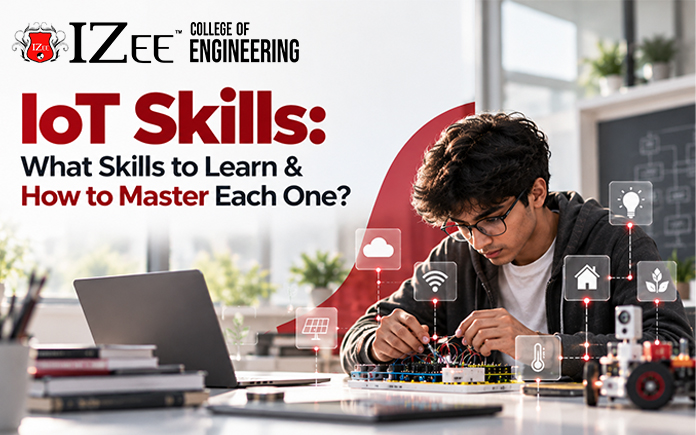
Internet of Things (IoT) connects physical devices to the internet so they can collect, share, and act on data. Hence, it can be said that IoT is running the whole world right now, including every MNC or organization that comes to your mind. This gives rise to a lot of valuable career opportunities in the area of IoT for people interested in programming, electronics, networking, data analysis, and cybersecurity skills. However, if you want to get these valuable opportunities, then expertise is also as important as skills. To build a successful career in this area, you need to master the top IoT skills to learn for any professional, which include different programming languages, electronics & circuit design, microcontrollers & embedded systems, networking protocols, communication protocols, sensor integration, cloud computing, use of different IoT platforms, IoT cybersecurity, and much more.
What Are the Top IoT Skills to Learn?
For B.Tech students as well as graduates, mastering the top IoT skills to learn while studying at one of the best electronics and communication engineering colleges in Bangalore can set you up well for a great career, not just in India, but all across the world. The following are the top 10 skills you should develop:
1. Programming
Programming forms the foundation of IoT because all the connected devices need instructions to collect sensor readings, process information, and control outputs. The following is everything you should master in programming languages for IoT:
- Learn variables, loops, conditions, functions, and basic logic.
- Scratch or another block-based coding environment.
- Python by writing programs that display temperature readings or switch an LED on and off.
- C and C++ when working with Arduino-compatible microcontrollers.
2. Electronics & Circuit Design
Understanding electronics is important to know how IoT devices interact with the physical world. It is one of the most essential skills for IoT developers all across the globe.
- Study the use and working of resistors, LEDs, switches, breadboards, and basic sensors.
- Learn about simple circuits and how to connect components safely.
- Start practice by building low-voltage circuits.
- Use a circuit simulator.
3. Microcontrollers
A microcontroller is a small computing device, one of the major components of IoT, used to read sensor inputs, operate outputs, and communicate with other devices. To perfect its usage:
- Explore beginner-friendly boards such as Arduino-compatible boards, Raspberry Pi Pico, or ESP32.
- Learn about input & output pins, digital signals, and analogue readings where supported.
- Write small programs that read a sensor and respond to changes.
- Gradually learn about memory, power consumption, and real-time responses.
4. Networking & Communication Protocols
IoT networking and communication protocols explain how Wi-Fi, Bluetooth, and other communication technologies connect a large number of devices together. To build expertise in these protocols:
- Learn basic concepts such as IP addresses, routers, bandwidth, and latency.
- Understand Wi-Fi and Bluetooth through simple connected-device experiments.
- Explore HTTP and MQTT, a lightweight messaging protocol commonly used in IoT.
- Practise sending sample sensor readings to a local dashboard or test environment.
5. Sensor Integration
Sensors are used in IoT devices to measure physical conditions such as temperature, humidity, light, motion, and distance. Learning sensor integration is important for any electronics & communication engineer, particularly for devices that are used in agriculture, environmental monitoring, and smart homes.
- Start with one sensor, such as a temperature sensor or light-dependent resistor.
- Learn how to read its output and convert it into meaningful measurements.
- Compare readings under different conditions and identify unusual values.
- Combine two or more sensors only after the first one works perfectly.
6. Cloud Computing
Through cloud computing, IoT devices send data to remote systems for storage, analysis, visualisation, and management. To develop all the necessary cloud computing skills:
- Learn the basic roles of a device, server, database, and user interface.
- Send sample data to a local computer or a beginner-friendly online platform.
- Explore dashboards that display sensor readings over time.
- Progress to services such as AWS IoT Core when comfortable with networking and basic programming.
7. Data Analysis
IoT systems can generate repeated measurements that become more useful when analyzed over time. Hence, data analysis helps students identify patterns, compare readings, and make the most accurate and reliable decisions rather than relying on a single measurement.
- Learn averages, minimum and maximum values, and simple comparisons.
- Record sensor readings in a spreadsheet.
- Create line charts to observe changes over time.
- Learn basic Python data analysis as projects become more advanced.
8. IoT Cybersecurity
IoT cybersecurity protects connected devices, the data they collect, and the networks they use. In the functioning of IoT systems, cybersecurity carries utmost importance in today’s time when cyberthreats are increasing every day. To master it:
- Understand why strong, unique passwords and secure authentication matter.
- Learn the purpose of encryption and software updates.
- Avoid exposing device dashboards or development boards directly to the public internet.
- Use test data and parent- or teacher-approved accounts when working online.
9. Troubleshooting and Problem-Solving
At some stage or another, you are sure to face a lot of problems which can be solved only by troubleshooting. To learn troubleshooting:
- Test one component at a time before assembling the whole system.
- Take note of all the error messages and check connections against the circuit diagram.
- Change one variable at a time and record the result.
- Keep a project log documenting faults, fixes, and lessons learned.
| IoT skills | Beginner learning goal | Suggested practice project |
| Programming | Learn logic and basic Python | LED control program |
| Electronics | Understand simple circuits | Button-operated light |
| Microcontrollers | Read inputs and control outputs | Sensor-based alert |
| Networking | Understand device communication | Send readings to a computer |
| Sensor integration | Measure physical conditions | Temperature monitor |
| Cloud computing | Display and store readings | Online or local dashboard |
| Data analysis | Interpret sensor data | Temperature trend chart |
| Cybersecurity | Apply basic security practices | Secure a test device |
| Troubleshooting | Find and fix faults | Diagnose a faulty sensor |
How to Master IoT Hardware and Software Skills?
Students can master IoT hardware and software skills by following a step-by-step learning process which involves understanding the fundamentals, practicing with beginner-friendly tools, building small projects, and gradually combining hardware with software. While studying at one of the top private engineering colleges in Bangalore, here is a simple process by which you can master IoT hardware and software skills:
Step 1: Build a Foundation in Mathematics, Science, and Coding
By learning basic mathematics and science, you can understand how sensors measure physical conditions and how devices interpret data. Additionally, overall programming teaches you about the logic needed to control those IoT devices.
- Practice logical reasoning, percentages, basic algebra, and reading graphs.
- Revise voltage, current, resistance, and simple electrical circuits.
- Start coding with Scratch or Python, depending on the learner’s experience.
- Connect every new concept to a practical example, such as measuring temperature or controlling a light.
Step 2: Choose Beginner-Friendly Learning Tools
After developing a good enough foundation, you should practice on beginner-friendly learning tools to hone your skills. These tools include:
- Raspberry Pi Foundation
- Arduino
- Scratch
Step 3: Start with Small, Practical IoT Projects
Facing failures and successes while working on real projects, even though they are small in scale, can help you master your skills like nothing else. Start with small projects and raise their scale with time:
- Beginners should build an LED circuit and control it using a simple program.
- Elementary IoT can be learnt by reading temperatures or light levels with a sensor.
- On the intermediate level, connect a sensor to a microcontroller and display readings on a computer.
- When you have advanced your skills, practice sending readings to a dashboard, analyzing trends, and increasing security.
Conclusion
By practicing all the IoT skills, you can develop expertise in programming knowledge, scientific thinking, creativity, and practical problem-solving abilities, all of them at once. However, this cannot be done without the right resources and guidance from experts. To get the right guidance and start on your path to a great career, you should enroll in a good engineering college.
One of the best engineering colleges in Bangalore is IZee Engineering College, a college trusted by hundreds of students to build a bright career for themselves.
Frequently Asked Questions (FAQs)
Q. What are the 5 C’s of IoT?
The 5 C’s of IoT are collect, connect, compute, comprehend, and control.
Q. What are the four pillars of IoT?
The four pillars of IoT are connectivity, data processing, user interface, and security.
Q. Is C++ used in IoT?
Yes, C++ is used in IoT for better speed, memory efficiency, having direct access to hardware and object-oriented abstraction (OOA).