Physics is the basis of every engineering specialty. From learning about mechanical systems to electrical circuits or writing algorithms, understanding physics is crucial to making technical learning easy and intuitive. This will give a real head start to students wishing to opt for any best engineering college in Bangalore when they start learning core subjects.
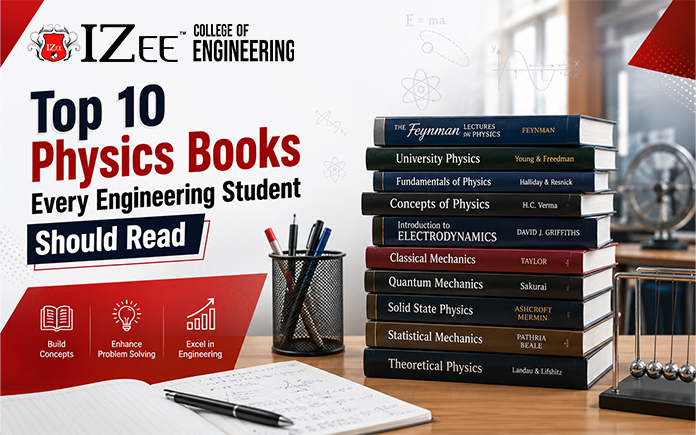
This is a selected list of 10 Physics books that every engineering student, in all the branches of engineering, should have in their library.
1. Concepts of Physics by HC VERMA
The two-volume set continues to be the classic for creating conceptual clarity in mechanics, thermodynamics and electromagnetism. It is a standard tool among students who are preparing for engineering entrance tests, and can still be useful in the first year of an engineering program.
2. University Physics (Young, Freedman)
A book which gives a detailed study of classical mechanics, waves and modern physics with clear derivations and examples of practical applications. A must-watch in most engineering physics courses.
3. Fundamentals of Physics (with modern physics) by Halliday, Resnick, and Walker.
This book is known for its problem-solving method and enhances analytical thinking. It is found useful by engineering students of all streams for relating theory to practical problems in engineering.
4. Author(s): B.K. Pandey & S. Chaturvedi, Engineering Physics.
Designed for engineering first-year courses in India, this book is a step towards the bridge between school-level physics and engineering-level applied physics.
5. The Feynman Lectures on Physics are a series of lectures delivered by Richard Feynman in 1963.
Ideal for students who want to understand physics beyond just the formulas, this three-volume series helps them do just that. It encourages the intuition needed to understand how physical principles become computing and electronics design, which can be of great benefit to anyone considering computer science or electronics.
6. Introduction to Electrodynamics, 4th Edition by David J. Griffiths
This book provides a comprehensive but easy-to-understand introduction to electromagnetic theory, which is the backbone of most modern technology, for students in electrical, electronics, or communication engineering.
7. Physics for Scientists and Engineers by Serway and Jewett.
This book is a combination of theory and application and is especially helpful for students interested in how principles of physics are used in engineering design and analysis.
8. Optics by Ajoy Ghatak
A concise textbook targeted for students in electronics, instrumentation and photonics-related fields. Describes wave optics and contemporary optical technologies in a structured and exam-oriented way.
9. Author(s): Carl J. Pratt
There are Physics textbooks for computer science, which are in need of bridges between classical and quantum physics, because quantum computing is more and more a relevant topic. A friendly introduction to quantum theory that helps CS students delve into new technologies.
10. Thermal Physics by Garg, Bansal and Ghosh
Mechanical, chemical and aerospace engineers all use thermodynamics. This book gives a clear explanation of heat transfer phenomena with solved examples based on engineering applications and thermal systems.
Why Physics Fundamentals Matter Across Different Engineering Disciplines
Physics is an integral part of a strong base and is not restricted to one field. It is used by mechanical engineers in different engineering disciplines such as dynamics and thermodynamics, by electrical engineers in circuit theory and by computer science engineers to understand various emerging areas such as quantum computing, signal processing and hardware. It’s in the first year of study that this foundational learning is focused upon by institutions such as IZee College of Engineering, and this allows students to shift gears in a more seamless manner so that they can choose their specialization.
Making informed book selections in the beginning can make a course easier and better loved, and can help develop real interest in the subject instead of just a test-taking interest.
FAQs
Q1. What is the best book for 1st year engineering students in physics?
The books Concepts of Physics by H.C. Verma and Engineering Physics by B.K. Pandey are recommended as the basic books for first year.
Q2. Is it necessary for computer science engineering students to study physics in detail?
Yes. Computing hardware is built on physics principles such as electromagnetism, optics and quantum mechanics, and these are the principles of new technologies such as quantum computing.
Q3. In selecting an engineering field, how is physics knowledge useful?
Students who have a good foundation in physics will be able to grasp the concepts of physics that apply to each of the engineering branches, which will provide them with a guideline on how to choose the branch that suits them best.
Q4. Are these books useful for engineering entrance exam preparation also?
Yes, there are a few books which are also used in the engineering entrance exam preparation courses, like Concepts of Physics and Fundamentals of Physics.