
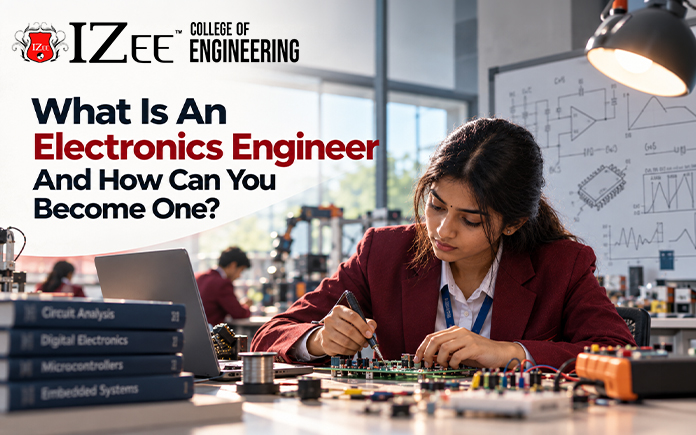
One of the core jobs in the IT industry, not just in India but all across the globe, is that of an electronics engineer. This role involves designing, developing, testing, and maintaining electronic circuits, devices, and systems used in smartphones, medical equipment, automobiles, communication networks, and industrial machines. Every student who aspires to become an electronics engineer enrolls in a B.Tech ECE program after Class 12. While it is a great career choice, you should know everything about the job, including what it involves, how you can get this job, what the average salary for this position is, and who the top recruiters for this position are.
What Is Electronics Engineering?
Electronics engineering is an engineering branch that involves designing, developing, and testing electronic circuits, components, and systems for a number of electronic, medical, navigational, communication, and industrial devices. The complete development of these things involves the use of various concepts from physics, mathematics and electrical principles, with computer-based tools, all of which collectively explain what is electronics engineering. Here is what an electronics & communication engineering program teaches you about it:
- Development of electronic devices and circuits
- Digital electronics
- Signals and systems
- Microprocessors and microcontrollers
- Communication systems
- Embedded systems
- VLSI design
- Instrumentation
What Is the Work of an Electronics Engineer?
The daily responsibilities of electronics engineers vary depending on their job role. On the overall front, it involves collaboration with software developers, electrical engineers, mechanical engineers, quality teams, and product designers. The common responsibilities of a person in this position are defined below:
| Responsibility | What you do |
| Circuit design | Design and analyze electronic circuits and select suitable components. |
| Hardware development | Build prototypes and integrate electronic components. |
| Testing and troubleshooting | Measure performance and identify faults using testing instruments. |
| Embedded systems | Work with microcontrollers, firmware, and hardware interfaces. |
| Communication systems | Develop or test systems that transmit and receive signals. |
| Semiconductor design | Help design, simulate, verify, or test integrated circuits. |
| Quality and reliability | Evaluate whether products meet specifications and operate consistently. |
| Manufacturing support | Monitor production processes and investigate defects. |
How to Become an Electronics Engineer in India?
Due to the ever-growing scope of enrolling in an electronics engineering course, many ECE students want to know how to become an electronics engineer in India. Having this job role as a career goal is one of the major reasons why students choose an ECE course in an EEE vs ECE comparison. Below are the steps you should follow to become an electronics engineer:
Step 1: Strengthen Your Core Electronics Concepts
Gain proficiency in the core electronics concepts such as:
- Circuits
- Digital electronics
- Analog electronics
- Signals and systems
- Microprocessors
- Circuit analysis
Step 2: Develop Practical and Technical Skills
To get a high-paying electronics engineering job, showing expertise through your practical and technical skills is important.
- Learn to use multimeters, oscilloscopes, and signal generators.
- Practice circuit simulation and PCB design.
- Develop basic programming skills in C, C++, or Python.
- Build expertise in microcontrollers, sensors, and embedded systems by working on small projects.
Step 3: Build Projects
Building your own small-scale projects helps greatly in showing your expertise to employers in the near or distant future.
- Build a sensor-based monitoring system or microcontroller-based device.
- Explore FPGA-based digital design if interested in VLSI.
- Develop a communication or signal-processing project using suitable simulation tools.
- Participate in college technical competitions, robotics clubs, or engineering project exhibitions.
Step 4: Complete Internships and Industry Training
To gain relevant experience required for this job position and train yourself to work in a professional environment, experts recommend that you do internships and take industry training during your academic years.
- Look for internships in semiconductor design, embedded systems, telecommunications, or electronics manufacturing.
- Explore the opportunities offered through your college’s placement cell and technical departments.
- Take feedback from supervisors and maintain a detailed record of the work you do.
Step 5: Prepare for Placements
Placements are the best chance you will get for an entry-level, well-paying job.
- Practise core ECE concepts along with technical interview questions.
- Prepare to explain your projects, design decisions, testing methods, and troubleshooting process.
- Create a resume highlighting your skills, internships, proficiency in tools, and projects.
What Are the Skills Needed to Become an Electronics Engineer?
The average electronics engineer salary in India is ₹3 LPA – ₹5 LPA for freshers. To get a job paying such a high salary, you need to develop a number of technical and soft skills over your academic years.
Technical Skills
- Analysis of various types of circuits
- Programming languages like C, C++, and Python
- PCB design
- Microcontrollers and embedded systems
- Use of simulation tools
- Fundamentals of semiconductors
Soft Skills
- Problem-solving
- Attention to detail
- Communication
- Teamwork
- Time management
- Continuous learning
Which Industries Hire Electronics Engineers in India?
To find the best electronics engineer jobs in India, you need to know who the top recruiters across industries are that are known for offering a great package as well as job security. To help you, the following are all the top recruiting organizations across industries for electronics engineers that you can aim to join:
| Industry | Top recruiters |
| Semiconductor and chip design | Qualcomm, Intel, Micron Technology |
| Electronics manufacturing | Tata Electronics, Foxconn, Dixon Technologies, Kaynes Technology |
| Telecommunications and networking | Ericsson, Nokia, Cisco |
| Automotive and electric mobility | Bosch, Tata Motors, Mahindra & Mahindra, Continental |
| Aerospace and defence | Hindustan Aeronautics Limited (HAL), Bharat Electronics Limited (BEL), DRDO |
| Industrial automation | Siemens, Honeywell, Schneider Electric |
| Medical electronics | Siemens Healthineers, Philips, GE HealthCare |
Conclusion
Electronics engineering is a versatile career path for students who enjoy physics, mathematics, technology, and practical problem-solving. A relevant BTech programme pursued at a good engineering college trains you for it, while your skills help you thrive for decades across industries.
Enroll in IZee College of Engineering for a BTech ECE programme, develop valuable skills under expert faculty, and set yourself on the path to a successful electronics engineering career.
Frequently Asked Questions (FAQs)
Q. How long does it take to become an electronics engineer?
It takes around 4 years to become an electronics engineer, as the BTech ECE course is 4 years long in its duration.
Q. Can an ECE student get a government job?
Yes, an ECE student can get a government job in India at ISRO, DRDO, Indian Railways, BSNL, BEL, ECIL, and NTPC.
Q. Is there coding in electronics engineering?
Yes, electronics engineering does involve coding through C, C++, Python, Assembly, MATLAB, Verilog, and VHDL.
Q. Is ECE in demand in India?
Yes, ECE is in high demand across India due to the continuous initiatives taken by the government for manufacturing products in India.
Q. Which companies hire electronics engineers in India?
Some companies that hire electronics engineers in India include Qualcomm, Intel, AMD, Broadcom, Honeywell, etc.