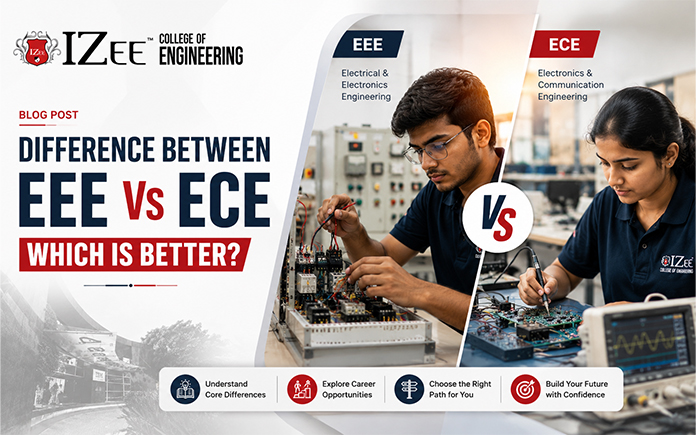
If you are thinking while you are filling out your engineering counselling form whether you should put in EEE or ECE, then you’re not the only one. They both sound like they could be the same type of career; they both involve electronics, and they both offer decent careers, so how do you choose? More importantly, how do you go about locating the best engineering colleges in Bangalore for the study of whichever branch you select?
The truthful answer: There is no one “better” branch of the family, only the branch that is better for you. In this blog, you will understand what EEE and ECE are all about, where they end up after graduation and how choosing one of the top engineering colleges in Bangalore can be beneficial for both choices.
What Is EEE, Really?
Electrical and Electronics Engineering (EEE) is a crosscutting field between power and electronics. It explains how electricity is produced, how it is carried, how it is regulated and how it is made use of. Consider your electric power plants, electric motors, transformers and more and more, electric vehicles and smart grids.
These are some areas where EEE engineers usually work:
- Power generation, transmission and distribution systems
- Electrical machines and control systems
- Renewable energy and EV technology
EEE is all about curiosity, whether you’ve ever wondered how a city maintains its lights on or how an EV battery is controlled.
What Is ECE, Really?
Electronics and Communication Engineering (ECE) is a field that embraces the realm of signals, chips, and connectivity. It’s the branch that’s behind your phone network, satellite communication and the chips in almost every smart device you have.
Typically, an Electronics & Communication Engineering program includes instruction in:
- Communication systems and wireless networks.
- VLSI and chip designing
- Using embedded systems, IoT and signal processing
The branch has remained current with each era of technology from telecom to 5G to AI-powered devices, and ECE graduates are well-equipped for any transition.
Core Subjects: A Quick Comparison
| Aspect | EEE | ECE |
| Focus | Power and electrical systems | Communication and electronics |
| Key subjects | Power Systems, Electrical Machines, Control Systems | Signals & Systems, VLSI, Embedded Systems |
| Industry ties | Energy, automation, EVs | Telecom, IT, semiconductors |
| Typical roles | Electrical Engineer, Power Systems Analyst | Communication Engineer, VLSI/Embedded Engineer |
| Higher studies | M.Tech in Power Systems, Renewable Energy | M.Tech in VLSI, Communication, Embedded Systems |
Career Scope: EEE Vs ECE
Both branches are always considered among the best options for engineering students, and there’s a reason for that.
The demand for EEE graduates is consistent in power utilities as well as in PSUs such as NTPC and BHEL, and also in the emerging EVs and renewable energy sector. Electricity does not disappear, so it is one of the safer, more recession-proof branches and is a good choice for GATE or electricity board exams.
ECE students are on the crest of the telecom, semiconductors and embedded technology waves. As India pursues electronics manufacturing ambitions and the world seeks more chip design expertise, ECE can lead to not just electronics but also software and IT roles, working on a 5G module this year and an IoT device next year.
Which One Should You Choose?
The easy way to make the decision: consider what gives you a greater sense of excitement.
Choose EEE if you:
- Like working with machines, motors and power systems
- Have an affinity for energy, automation or electric mobility
- Steer clear of industries that are new and have no proven demand.
Choose ECE if you:
- Love chips, networks and connected devices
- Desire to switch from hardware to software jobs and vice versa.
- Staying up to date with the latest tech trends, such as IoT and AI hardware.
Neither road prevents you from having opportunities on the other road completely. Many EEE graduates learn programming and find jobs in IT fields, and many ECE graduates specialize in power electronics. Your degree is not a cage; it’s a foundation.
Why the Best Engineering Colleges in Bangalore Give You an Edge
The part that students tend to miss is that it’s not just the branch. The opportunities, exposure, and network you have developed during your studies are dependent on where you studied.
The city of Bangalore has emerged as one of the best City for engineering students in India, albeit in a stealthy manner. It has the highest density of IT parks, electronics companies and R&D centres in India and internships, guest lectures and placement pipelines are a breeze. As an ECE or EEE student, you will have access to all the companies that are developing semiconductors, telecom, and embedded systems right in your vicinity, so you’ll get a first-hand look at the industry you’re planning to join.
This is why students looking for the ‘best engineering colleges in Bangalore’ should opt for a campus that not only has a solid foundation but also offers hands-on experience.
IZee College of Engineering: A Top Pick Among Bangalore’s Best
Izee College of Engineering is known as one of the top engineering colleges in Bangalore because they have been delivering this perfect mix of academics and industry relevance.
Students have been choosing IZee for a few reasons:
- Well-rounded EEE and ECE programs balance theory and hands-on lab work.
- Industry-relevant faculty who can provide industry relevance to the class.
- Excellent placement support for core and IT-related positions.
- State-of-the-art laboratories for embedded systems, power electronics and communication.
- Turning Bangalore’s ecosystem at the doorstep, making internships accessible.
Living in a techno hub city and having a curriculum that aligns with the same technology provides a real advantage to the EEE and ECE students.
Final Thoughts
So, between EEE and ECE, which is better? That’s up to you – not up to some ranking of one branch over another. EEE is a place of stability and a foothold in the world’s never-ending transition towards clean energy. ECE is flexible and accommodates all the new waves of connected technology. They’re both great choices for the future.
Where you attend school is what will really make a difference in your life when it comes to your career. Selecting one of the best engineering colleges in Bangalore, such as IZee College of Engineering, provides both EEE and ECE students with exposure, guidance and opportunity to make a good branch into a great career.
Before you make your final decision, you may want to look around, talk to students who attend the college, and tour the labs.
FAQs
1. Which is better, EEE or ECE?
Neither is objectively better. EEE suits students drawn to power and energy systems; ECE suits those drawn to communication and electronics. The right choice depends on your interest, not rankings.
2. What is the salary difference between EEE and ECE?
Starting salaries are largely similar and depend more on the company, skills, and location than the branch itself. ECE grads in telecom or VLSI and EEE grads in core power roles can both command strong packages.
3. Is ECE easier than EEE?
Not really, they’re just different kinds of hard. EEE leans more into electrical machinery and mathematics, while ECE leans more into electronics and communication theory. Difficulty comes down to personal aptitude.
4. Can EEE students switch to IT jobs?
Yes. Many EEE graduates learn programming alongside their core subjects and land roles in IT and software companies, just like ECE graduates do.
5. Which are the best engineering colleges in Bangalore for EEE or ECE?
Look for colleges with strong labs, industry-experienced faculty, and solid placement records. IZee College of Engineering is a popular pick for exactly this reason, alongside its Bangalore location.
6. Is IZee among the best engineering colleges in Bangalore?
Yes. IZee offers updated labs, experienced faculty, and placement support for both EEE and ECE, along with the added advantage of being based in Bangalore’s tech ecosystem.