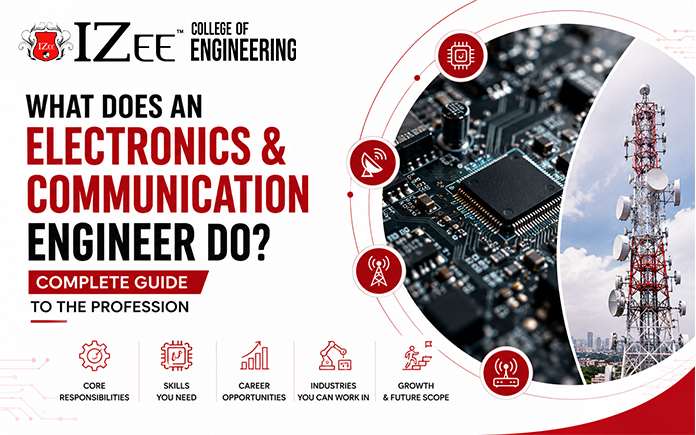
The electronics and communication engineering (ECE) is one of the most popular engineering disciplines in the present day, powering almost every electronic device, from smartphones to satellites, the Internet of Things (IoT) to 5G networks. However, what is an ECE engineer really doing on a day-to-day basis and what sorts of careers await after graduating?
This guide gives a brief overview on the scope of BTech Electronics & Communication Engineering program, the jobs available after ECE, IZee College of Engineering in Noida, UP.
What is Electronics & Communication Engineering?
Engineering that involves the design, development and testing of electronic devices, circuits and communication systems is known as ECE. Being one of the most general engineering disciplines, it bridges the gap between electronics (circuits, semiconductors, embedded systems) and communication technologies (signal processing, networking, wireless systems).
What is the job of an ECE Engineer?
Typical duties of an Electronics & Communication Engineer are:
- Design electronic circuits and systems: Developing and verifying circuits for consumer electronics, industrial equipment and communication systems.
- Designing communication systems: Designing network, satellite, wireless and telecom infrastructure systems
- Embedded systems programming: Designing a system that uses a microcontroller for automotive, healthcare, and IoT devices.
- Signal processing: Studying and working with signals for things such as audio/video processing, radar, and imaging.
- Testing and quality assurance: It ensures that electronic products and systems perform and are safe to use
- Research and development: Creation of new technologies in semiconductors, VLSI design, and next generation networks (5G/6G)
The key skills engineers need to be successful in this industry include:
- Designing and evaluating circuits.
- Programming languages (C, C++, Python, Verilog/VHDL)
- Signals, communication systems and their basic components.
- Embedded systems and microcontrollers.
- PCB design tools
- Problem solving and analysis abilities
BTech ECE Scope
The BTech ECE scope covers some of the most flourishing fields in the technology sector today:
- Telecommunications and network engineering: 5G/6G infrastructure, wireless communication
- Computer Hardware: processors, motherboards, and CPUs
- Semiconductor Industry: design of chips and VLSI (which is rapidly growing in India).
- Smart Devices in Automotive, Healthcare and Industrial Automation: embedded devices and IoT.
- Aerospace and Defense: radar systems, satellite communication and avionics
- Many ECE graduates also go into IT and Software, as they have solid programming skills.
India’s expanding interest in semiconductors manufacturing and digital infrastructure keeps increasing year after year for the skilled ECE graduates.
Jobs After ECE
The following are some of the most popular career paths and jobs after ECE:
- Electronics Engineer
- Communication/Network Engineer
- Embedded Systems Engineer
- VLSI Design Engineer
- Signal Processing Engineer
- Telecom Engineer
- IoT Developer
- Software Developer (Many ECE grads make the leap into IT)
- Research & Development Engineer
Higher studies can also be taken up (MTech/MS) along with Government Sector jobs through various competitive exams like GATE, which are eligible for PSUs like BSNL, ISRO, DRDO etc.
Why Choose an ECE Program at IZee College of Engineering?
Selecting the institute is just as important as the course you’re interested in when it comes to choosing an Electronics & Communication Engineering program. The curriculum at IZee College of Engineering is structured to prepare students with skills that are relevant to the industry, hands-on laboratory sessions, and provides adequate placement support to help them develop a strong base in core engineering, as well as in an IT career after joining the workforce.
Conclusion
As one of the broadest and future-proof branches of engineering, Electronics & Communication Engineering can be pursued in a variety of careers ranging from telecom to semiconductors to embedded systems to software. Whether you are just beginning to look into the career or already enrolled in an ECE program, establishing solid building blocks early will pave the way for a variety of different fields.
Also relevant: Engineering Student Should Read: a useful list of Physics books to improve the basic aspects of Engineering.
FAQs
1. What is an Electronics & Communication Engineer?
They develop, design and test embedded devices, communication and electronic circuits in telecom, consumer electronics and industrial applications.
2. What are the subjects covered in BTech ECE?
BTech-ECE provides a broad spectrum of opportunities in the telecom, semiconductors and IoT, embedded systems, aerospace and IT/software sectors.
3. What can I do with ECE?
Popular positions are Electronics Engineer, Network Engineer, Embedded Systems Engineer, VLSI Design Engineer and Software Developer.
4. In your opinion, is ECE a good branch to pursue in the future?
Indeed, ECE is one of the more future-proof branches of engineering due to the growing demands of 5G/6G, semiconductors and IoT.
5. Is it possible to change careers from ECE to IT?
Yes, a lot of ECE graduates switch to software and IT jobs because of their programming and problem solving skills.