Information Science and Engineering is one of the courses that students planning to make a career in tech are opting for and it’s no surprise for a quiet one. It is embedded in the computer science, data and information systems disciplines providing graduates with a versatile skill set that is sought after by all industries.
This guide explains all that a student or parent should know: course content, job market, and what to expect semester-by-semester, as well as what to expect in terms of salary.
What Is Information Science and Engineering?
Information Science and Engineering (ISE) is an engineering field that deals with the collection, storage, processing and transmission of information through computing systems. It is expected to be similar to Computer Science Engineering but with an added emphasis on knowledge of databases, information systems, networking and data management along with programming and software technologies.
Because graduates are well prepared to assume roles as software developers, data analysts, systems engineers, database administrators, and other positions, the branch has become popular in tech hubs.
Why Study Information Science Engineering in Bangalore?
Bangalore isn’t only the IT Capital of India, it’s where interns intern, hackathons hack, and entry-level tech hires get hired. Studying information science engineering in Bangalore, you’re right in the middle of a hub of product startups, IT services, and IT companies, which is of significant importance for internships, real industry projects, and campus placements.
This is also one of the reasons why it is important to select the right institution. A top engineering college in Bangalore is not only teaching a syllabus, it’s fostering industry links, effective placement cells, and keeping its labs and curriculum fresh with the latest industry needs.
Before deciding on a particular branch of engineering, if you’re still uncertain about whether or not you should pursue one at all, you’ll want to read consider an engineering degree first.
Information Science Engineering Syllabus: What You’ll Study
While the exact structure varies slightly by university, most ISE programs follow a similar core over four years:
First Year (Foundation)
- Engineering Mathematics
- Physics/Chemistry (as applicable)
- Basic Electrical & Electronics
- Introduction to Programming (C/Python)
- Engineering Graphics
Second Year
- Data Structures and Algorithms
- Object-Oriented Programming (Java/C++)
- Digital Logic Design
- Discrete Mathematics
- Database Management Systems
Third Year
- Operating Systems
- Computer Networks
- Web Technologies
- Software Engineering
- Data Mining and Data Warehousing
- Cloud Computing
Fourth Year
- Artificial Intelligence & Machine Learning
- Big Data Analytics
- Information Security & Cryptography
- Mobile Application Development
- Major Project / Capstone
Electives in areas like Data Science, Blockchain, and IoT are increasingly common, letting students specialize based on where they see the industry heading.
Career Scope After Information Science Engineering
This is where ISE genuinely shines: the degree doesn’t box you into one narrow role. Common career paths include:
| Role | What You’d Be Doing |
| Software Developer / Engineer | Building applications across web, mobile, and enterprise systems |
| Data Analyst / Data Scientist | Working with data pipelines, analytics, and increasingly AI-driven insights |
| Database Administrator | Managing and securing organizational data systems |
| Network Engineer | Designing and maintaining IT infrastructure |
| Systems Analyst | Bridging business needs and technical solutions |
| Cybersecurity Analyst | Protecting systems and data from threats |
| Cloud Engineer | A fast-growing niche as more companies move infrastructure to the cloud |
Beyond the private sector, ISE graduates also find opportunities in government departments (railways, public sector undertakings, aviation) and can pursue higher studies (M.Tech, MBA, or study abroad) to move into research or leadership tracks.
Information Science Engineering Salary: What to Expect
Salary figures vary by source, city, company type, and individual skill set, but a few consistent patterns show up across industry salary data:
| Career Stage | Typical Salary Range | Notes |
| Freshers | ₹3.5–7 LPA | At Indian IT services and product companies; higher end for candidates from colleges with strong placement records and in-demand skills |
| Mid-career (3–6 years) | ₹7–15 LPA | Especially with specialization in areas like cloud, data engineering, or cybersecurity |
| Senior / specialized (AI/ML, data science, cloud architecture) | ₹20–30+ LPA | For experienced professionals in high-demand skill areas at product companies and MNCs |
Government-sector roles tend to offer more modest but stable starting packages, generally in the ₹2.5–9 LPA range depending on the department and role.
Skills That Make ISE Graduates Employable
Beyond the syllabus, employers consistently look for:
- Strong fundamentals in data structures and algorithms
- Proficiency in at least one modern programming language
- Working knowledge of databases (SQL and NoSQL)
- Familiarity with cloud platforms (AWS, Azure, or GCP)
- Basic exposure to AI/ML concepts and tools
- Problem-solving ability demonstrated through projects, not just coursework
Colleges that build these into the curriculum through hands-on labs and live projects, rather than treating them as theoretical add-ons, tend to produce more placement-ready graduates.
Why Choose IZee College of Engineering for ISE
IZee College of Engineering takes an industry-focused approach to the field of Information Science and Engineering: state-of-the-art labs, hands-on projects, and courses that are current and relevant to the latest trends in the tech industry, ranging from cloud computing to data analytics and artificial intelligence. In addition to this, the presence in Bangalore’s booming tech hub provides students with first-hand exposure to internships and placements, which are not as readily available in other parts of the country.
If you are considering one of the information science and engineering courses offered in the city, you will want to consider more than just what you will be learning in the classroom on paper; you’ll want to consider the placement history of the faculty, their industry experience, and the quality of the lab equipment, among other things, as they all contribute to your readiness on your first day of your first job.
Final Thoughts
Information Science Engineering is one of the most flexible, future-proof courses available in the tech education discipline today, with a robust career trajectory, healthy salary potential and an evolving curriculum. The branch provides you a solid foundation, you are going to get how far from that foundation by where and how much you interact with it in the process.
Not sure if engineering is for you? Start with Consider an Engineering Degree to think through the decision before narrowing down a branch and a college.
Frequently Asked Questions
1. What is the difference between Information Science Engineering and Computer Science Engineering?
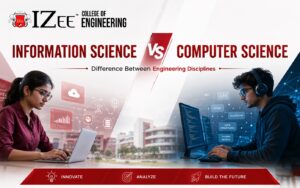
ISE has a good base of programming and software, with a bias towards information systems, databases and data management, whereas CSE tends to be more in-depth with the core theory of computing, algorithms and systems design.
2. Is Information Science Engineering a good branch for placements?
Yes. ISE graduates are hired for many of the same roles as CSE graduates, including software development, data analytics, cloud, and systems roles, especially from colleges with strong industry ties, like those based in Bangalore.
3. What is the average starting salary after Information Science Engineering?
The salary range of most freshers is between ₹3.5–7 LPA, but this is dependent on the college, skill sets and hiring company. For project skills, candidates with cloud, data, AI/ML skills tend to get offers at a higher end.
4. Can Information Science Engineering graduates pursue higher studies?
Absolutely. A significant number of ISE graduates continue their studies with an M.Tech, an MBA or Master’s degree in a different country, preferably in a specialized field such as data science, AI/ML or cybersecurity.