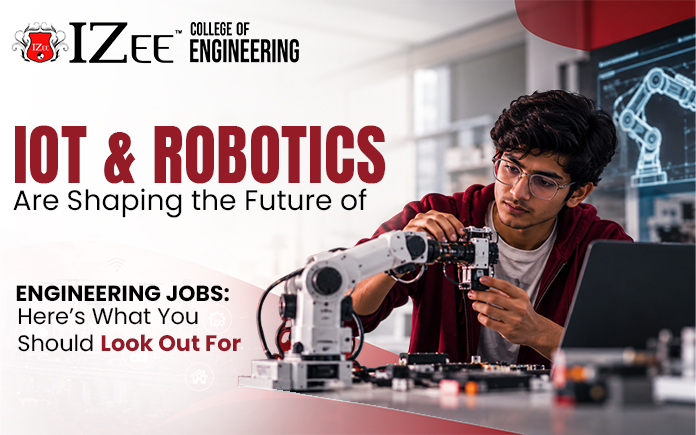
With passing years, the demand for engineering courses and jobs is constantly increasing. This increase is seen most in the IoT & Robotics engineering field due to the exponential growth of automation, Artificial Intelligence (AI), sensors, robotic systems, etc., across almost all industries. With the growing choice for a career in these fields comes the growth in competition among IoT & robotics engineering jobs India. To survive in such a situation, everyone needs advanced skills to stand out in the eyes of employers. These include electronics, programming, data, automation and problem-solving skills, along with staying updated with industry trends to fit in and build a successful career for yourselves.
What Is IoT & Robotics Engineering?
IoT and robotics engineering brings together electronics, computer science, mechanical systems, programming, communication technologies, and automation. While IoT focuses on the ability of physical devices to collect, exchange, and analyze data, robotics focuses on performing a variety of physical tasks using machines. For students and professionals across India, learning about the following disciplines is important to find the best specialization to base their career on:
- Internet of Things
- Robotics
- Embedded systems
- Automation
- Artificial intelligence
- Computer vision
- Cloud and edge computing
What Skills Should You Develop for IoT & Robotics Engineering Jobs India?
In today’s competition-filled job market, skills are the most important to get your dream IoT & robotics engineering jobs India. The following are some skills that employers look for the most:
1. Electronics and Embedded Systems
IoT devices and robots interact with the physical world through electronic components. To make them work, you need a solid foundation in circuits, sensors, microcontrollers, and actuators. Useful areas to build your learning in include:
- Microcontrollers
- Device interfacing
- Raspberry Pi
- Sensors
- Actuators
- Basics of digital & analogue electronics
- Circuit troubleshooting
2. Programming and Software Development
While pursuing an electronics & communication engineering program, you learn that programming and software development are central to modern IoT and robotics systems. Here is what you should learn among them:
- Python, C, and C++ programming languages
- Object-oriented programming
- Data structures & algorithms
- APIs & software integration
- Debugging & testing
3. Sensors, Networking, and IoT Protocols
Connected devices need reliable ways to collect, transmit, and exchange information. This explains the importance of networking in IoT engineering, which includes:
- Wi-Fi and Bluetooth
- TCP/IP fundamentals
- MQTT
- HTTP
- CoAP
- Device gateways
- Cloud connectivity
- Edge computing
- Device authentication
- IoT cybersecurity
4. Robotics, Automation, and Control
For a successful career in robotics engineering, some of the major skills you need revolve around understanding how machines move, sense their surroundings, and respond to commands. This includes:
- Robot kinematics & dynamics
- Motors & motor control
- Robot programming
- Industrial automation
- PLC fundamentals
- Control systems
- Autonomous systems
5. AI, Data, and Machine Learning
The working of modern robots and IoT systems involves generating and processing large amounts of data. This use of the technology involves applications of concepts like:
- Machine-learning fundamentals
- Computer vision
- Data analysis
- Predictive maintenance
- Data visualisation
- Edge AI
- Pattern recognition
- AI-assisted automation
6. Problem-Solving and Communication
Technical skills are not the only skills you need to excel in this field, as several human-like qualities, which are mentioned as follows, influence the working of robots and IoT systems:
- Analytical thinking
- Logical reasoning
- Technical communication
- Documentation
- Troubleshooting
- Continuous learning
How Are IoT & Robotics Engineering Jobs Changing?
Change is constant with time in every domain, including IoT and robotics jobs. According to various industry-relevant reports, these changes include not just the way of working but the responsibilities that come along with your work in this domain. Graduating from one of the best engineering colleges in Bangalore prepares you for the same.
Today, engineers are increasingly expected to work in an interdisciplinary manner with connected equipment, automation, data, and intelligent systems. For example, a robotics project requires knowledge of mechanical systems, electronics, embedded programming, sensors, networking, and AI. Being well-versed in the theoretical part of these concepts as well as their practical applications helps you be better prepared for changing employer requirements.
In detail, here’s what the future of robotics and the future of IoT in India looks like:
- More system integration with the use of sensors, machines, software, and communication systems.
- Greater use of AI.
- Growth of industrial automation.
- More data-driven engineering.
- Greater focus on cybersecurity for authentication, secure communication, and protection of connected systems.
- Multidisciplinary job roles.
- Continuous upskilling by learning about new platforms, programming tools, and automation technologies.
Why Should You Study IoT & Robotics Engineering?
As the future of electronics & communication engineering looks very technically advanced and competition-filled, many students wonder whether pursuing a course in this and learning about IoT & robotics engineering is worth it or not. If you are one such student, then you should know that it is absolutely worth it to go down this path due to the multiple engineering career pathways, growing adoption of this technology, and many other reasons.
1. Multiple Engineering Career Pathways
The robotics and IoT career scope India is growing greatly, as their concepts can be applied to several engineering functions, allowing you to explore multiple engineering career pathways. This includes roles such as:
- IoT engineer
- Embedded systems engineer
- Robotics engineer
- Automation engineer
- Control systems engineer
- Industrial IoT engineer
- Robotics software engineer
2. Growing Adoption Across Indian Industries
Robotics and connected technologies are being adopted by various industries, leading to an increase in the number of jobs across India. The following are those industries:
- Automotive manufacturing
- Electronics manufacturing
- Logistics
- Warehousing
- Healthcare
- Agriculture
- Energy
- Food processing
- Industrial manufacturing
3. Strong Foundation for Emerging Technologies
The concepts of IoT and robotics overlap with several developing technology areas, setting up your foundational knowledge for:
- Artificial Intelligence (AI)
- Machine Learning (ML)
- Computer vision
- Edge computing
- Autonomous systems
- Smart manufacturing
- Industrial data analytics
Conclusion
Consistent growth in IoT and robotics engineering is changing the job market, and the best thing you can do is be prepared for this growth right from your academic years. For an overview, your preparation for a successful engineering career in the long term should start by building a great foundation and staying updated with industry trends.
This preparation can happen only when you choose the right college for yourself, one of which is IZee Engineering College, Bangalore, offering excellence to students with big dreams through its B.Tech ECE course.
Frequently Asked Questions (FAQs)
Q. Which is better, IoT or robotics?
Neither IoT nor robotics is a completely better field. Choosing the better one out of the two depends on your interests, as IoT provides easier entry into cloud computing, networking, and data analytics, while the work in robotics is a blend of mechanical engineering, kinematics, and motion control.
Q. What skills are needed to work in robotics?
The most important skills needed to work in robotics include computer programming (Python and C++), ROS, Machine Learning (ML), math, electrical and mechanical engineering, systems thinking, problem-solving skills, and more.
Q. Is robotics a high paying job?
Yes, robotics is one of the highest-paying jobs in today’s time. In this engineering domain, freshers get a salary package of ₹4 LPA to ₹8 LPA, while seniors earn around ₹24 LPA.
Q. Does robotics require coding?
Yes, robotics does require coding for programming the hardware movement, sensing abilities, and decision-making.
Q. What companies need robotics engineers?
Companies that hire robotics engineers the most in India include ABB, FANUC, KUKA Robotics, Yaskawa, Siemens, and GE Vernova.